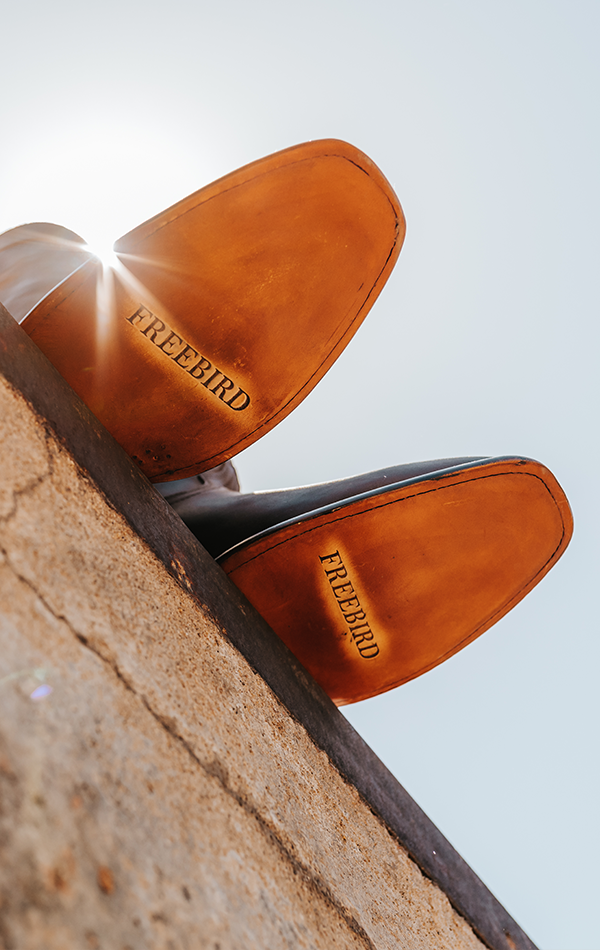
You find the boots. You picture the outfit. Then comes the question: Which size should I order?
With leather footwear, the answer is not always as simple as choosing the number you wore in your last pair. Different silhouettes are built differently, and everything from the toe shape to the shaft construction can influence the fit.
A new pair should feel comfortably snug and supportive, not painfully tight. Your toes need room to move, your foot should feel secure, and the leather should hold you without pinching or restricting movement.
This guide walks through choosing your Freebird size, measuring your feet and calves, understanding product measurements, and checking whether a new pair fits before you begin breaking it in.
Key Takeaways
- Start with your everyday U.S. shoe size and the specific style’s Fit Tip. Foot width, socks, and your preferred fit also matter.
- There is no universal rule for half sizes. Some styles call for sizing down; others call for sizing up.
- A little heel movement can be normal in a new pull-on boot. Excessive slipping or sliding forward is different.
- Measure both feet and both calves. Use the larger measurement when evaluating fit.
- Try new footwear on carpet before wearing or treating it. Check the fit first, then decide whether to begin break-in.
What Size Freebird Boots Should You Order?
Start with two questions:
What is your typical everyday shoe size? And would you describe your feet as narrow, average, or wide?
Those are the starting points our team uses to help customers find their fit. A size from another specific sneaker or boot brand is less useful because that brand may fit differently.
From there, check the Fit Tip on the individual Freebird product page. This tells you whether the style runs true to size or if you may want to size up or down based on the fit.
Think of it this way:
Your everyday U.S. shoe size + the style-specific Fit Tip = your best starting point.
Then consider your foot width, the socks you plan to wear, and whether you prefer a snug or roomier fit. Those details help refine the recommendation.
Why Your Size Can Change Between Styles
Every style is shaped around a last: the three-dimensional mold that determines the footwear’s length, width, toe shape, proportions, and fit.
That means a round-toe shoe, a pointed-toe boot, and a tall pull-on silhouette may feel different even when the size printed inside is the same. One may provide more room through the footbed, while another has a narrower or more elongated shape.
One of the most common sizing mistakes is assuming that the size you love in one Freebird style will automatically be the right choice in every other style.
Your existing pair is a helpful reference, not a reason to skip the next Fit Tip.
Between Sizes? Here Is How to Read the Fit Tip
When a Fit Tip says to size up between sizes, it means moving to the next whole size. For example, a customer who normally wears a 6.5 would choose a 7.
The direction can change by style. These examples from the Freebird team show why:
| Style | Usual size | Team sizing example |
|---|---|---|
| RANDI | 8.5 | Size down to 8 |
| JULES | 6.5 | Size up to 7 |
| COAL | 7.5 | Size up to 8 |
These are examples of style-specific half-size guidance, not a single rule for the entire collection. Foot width and preferred fit remain part of the decision.
Your Socks and Fit Preference Matter, Too
For a boot described as true to size, a customer between sizes who wears thin dress socks may prefer sizing down. Someone planning to wear thick winter socks, or who prefers a roomier feel, may prefer sizing up. A wider foot can also change the recommendation.
The key distinction is a snug fit versus a painfully tight one. New leather may feel firm, but choosing a smaller size should not mean accepting painful pressure or a restrictive fit.
How Boots Should Fit at the Toes, Heel, and Instep
Instead of asking only, “Are these tight?” check where, and how, the boot holds your foot.
Toe Room: Your Toes Should Not Feel Scrunched
There should be room for your toes to move comfortably. They should not feel compressed or pushed against the front of the shoe.
Toe shape influences the space available. Within the Freebird collection, the team describes the main shapes this way:
| Toe shape | What to know about the shape and fit |
|---|---|
| Square | The roomiest toe shape, with a wider, more open toe bed. |
| Round | A naturally rounded shape with comfortable toe room, though generally less spacious than a square toe. |
| Almond | A softly tapered shape between round and pointed, typically with a longer, narrower profile. |
| Pointed | The most tapered shape, with a narrower toe bed. Between-size customers may need to size up according to the style’s Fit Tip. |
| Snip | An intentionally elongated silhouette. The visible length alone does not tell you whether the boot is too large. |
Judge the fit by how your foot sits inside the boot, not by expecting your toes to fill every part of its outer shape. This is particularly important with pointed and snip-toe silhouettes.
If your toes press against the end, reassess the size or consider another toe shape rather than assuming break-in will solve the problem.
Heel Fit: A Little Movement Can Be Normal
A new pull-on boot does not need to hold your heel completely still.
The Freebird team advises that approximately ¼–½ inch of heel movement can be normal in a new pull-on boot. As the leather and footbed break in, that movement should become less noticeable.
This is specific to the construction, not a target for every shoe. Zip-up and lace-up styles generally hold the ankle more securely and should have less heel movement.
The boot may be too large if your heel lifts excessively, your foot slides forward, or you feel as though you are walking out of it. Needing to over-tighten the laces or pile on extra socks simply to keep the boot secure can also signal a poor fit.
The goal is a secure, comfortable stride, not a completely immobile heel.
Width and Instep: A Firm Hug, Not a Painful Squeeze
The instep is the area across the top of your foot. Along with the widest part of your forefoot, it should feel snug and supported without pinching or painful pressure.
A boot that is difficult to put on is not automatically the wrong size. If it feels comfortable once your foot is fully inside, the opening may simply need time to soften. Continued pressure across the width or instep is a different issue.
If sizing up solves the width problem but creates too much length or heel movement, another silhouette may be a better match.
How to Measure Your Calves for Tall Boots
For tall boots, checking your foot size is only part of the process. Calf measurements help you assess the shaft before ordering.
Use a soft measuring tape and follow these steps:
- Stand naturally. Distribute your weight evenly and keep your calf relaxed.
- Find the widest point. Wrap the tape around it, keeping the tape level and parallel to the floor.
- Keep the tape snug, not tight. It should touch your leg without squeezing or digging into your skin.
- Measure both calves. Use the larger measurement for your comparison.
- Include your planned layers. Measure over the jeans, socks, or other clothing you expect to wear inside the boots.
What About Boots That End Below the Widest Part of Your Calf?
Also measure your leg where the top of that shorter shaft will sit. The circumference at that point may be more relevant than the widest part of your calf.

Keep the measurement location in mind when comparing it with the product details: the team describes the listed shaft circumference as a measurement around the widest part of the boot shaft, which is not necessarily the opening on every silhouette. For a close fit, ask Customer Experience to help compare the relevant points.
Understanding Heel Height, Shaft Height, and Shaft Circumference
The team takes measurements from new boots before they have been worn. Women’s product measurements are provided in inches using a size 8 as the reference.
Here is what the three main measurements describe:
| Measurement | What the team measures |
|---|---|
| Heel height | From the bottom of the heel to the point where the heel meets the shoe. |
| Shaft height | From the top of the heel, where it meets the shoe, to the top of the boot shaft. The heel itself is not included. |
| Shaft circumference | Around the widest point of the shaft using a soft measuring tape, without compressing the leather. |

These figures provide a baseline for the proportions of a style, not an exact measurement guarantee for every pair. Handcrafted footwear can vary slightly.
Measurements that can be affected include heel height (depending on the in-step and last), shaft height, and calf circumference. While these differences, if any, are typically minimal, they are a natural result of creating well-balanced proportions across the full size range.
As leather warms, softens, and molds with wear, the shaft may also relax and flex. Use the published measurements as a starting point, not a promise that a restrictive shaft will eventually fit comfortably.
Adjustable Shafts vs. Relaxed Shafts: Know the Difference
A soft, slouchy-looking boot is not automatically a roomier boot.
A relaxed shaft describes how the leather sits and moves. It still has a defined construction and circumference.
An adjustable design includes a feature that allows you to change the fit, such as lacing, buckles, or flexible panels.
The team highlighted several examples:
COAL features adjustable back-panel lacing that lets you loosen or tighten the fit around the calf for a more customized fit.
WOLFGANG has a functional exterior zipper that allows the shaft to open slightly.
BOWIN includes flexible gore detailing that can help accommodate wider ankles.
RANDI uses adjustable buckles to personalize the fit around the foot and instep. That is useful adjustability, but it serves a different area than calf lacing.
Look for the feature that addresses your particular fit concern. Extra flexibility around the ankle, for example, is not the same thing as additional room around the calf.
Do Boots, Booties, Shoes, and Sandals Fit Differently?
The overall goal stays the same: comfortable support without pinching, sliding, or restriction. The areas that deserve the most attention change with the silhouette.
Pull-on boots should feel secure through the instep while allowing some initial heel movement. Zip-up and lace-up styles generally provide more security around the ankle.
Tall boots need a comfortable calf and shaft fit in addition to the right foot size. Booties place more emphasis on the ankle, heel, and instep.
Higher heels make a secure fit especially important because more weight shifts toward the ball of the foot. Your foot should feel stable rather than sliding forward.
Closed-toe shoes need enough room for the toes to move without pressing against the front. In sandals, the heel and toes should remain comfortably within the footbed, with straps that hold securely without digging in.
Your At-Home Boot Fit Check
Try your new footwear on as soon as it arrives, on a clean, carpeted surface. Carpet helps protect the soles while you decide whether the fit is right.
Before judging the size, put on the socks you intend to wear and fully loosen any adjustable laces, buckles, or straps. Once your feet are seated, adjust the closures and try both shoes together.
Walk around on carpet and check the toes, width, instep, heel, and, on tall boots, the calf. The fit should feel comfortably snug and supportive without painful pressure.
If something feels wrong, stop before wearing the pair outside or applying a treatment.
Keep Return and Exchange Eligibility in Mind
Eligible unworn items must be returned within 30 days of delivery and meet the full return-policy requirements. Final Sale items are not eligible for return or exchange. Review the Returns & Exchanges Policy and any purchase-specific restrictions before committing to a pair.
Footwear that has been worn, stretched, treated, or otherwise modified may no longer qualify. Confirm the fit before moving on to break-in methods that alter the shoes.
Boot Fit Troubleshooting: What Should You Do Next?
| What you notice | What the team recommends |
|---|---|
| Your toes press against the end. | Reassess the size. The style may be too short; consider another size or toe shape. |
| Your footbed feels squeezed. | Consider another size or a roomier silhouette. Square-toe styles generally provide the most footbed room within the collection. |
| Your heel slips excessively or your foot slides forward. | Reassess the size or consider a more secure closure. A little heel movement in a new pull-on boot is different from excessive slipping. |
| Your instep feels painfully tight. | Consider another size or style. The instep should feel supported, not painfully restricted. |
| Your foot will not pass through the opening. | If your Western boot feels difficult to pull on, that does not always mean you need a larger size. Try the plastic-bag trick covered in our break-in guide to help ease your foot through the shaft and into the footbed. |
| Your foot fits, but the shaft will not close comfortably. | Consider a roomier shaft or an adjustable closure. |
| One foot fits differently from the other. | Fit to the larger foot. The team may suggest socks or an appropriate insole to help accommodate the smaller foot. |
These are helpful starting points for troubleshooting. If your size, width, and shaft fit point in different directions, our Customer Experience team can help you find the best fit.
Is It the Wrong Size, or Does It Just Need Breaking In?
New full-grain leather can feel firm before it softens and molds with wear. That does not mean every tight area should be ignored.
The team describes the distinction simply: a firm hug is different from a restrictive fit.
If the boot feels secure and your toes have room, some initial firmness may be normal. If the fit feels painfully tight, your toes press against the end, or the instep remains restrictive, reassess the size or silhouette instead of relying on break-in.
Once you are confident in the fit and have decided to keep the pair, the Leather Footwear Break-In Guide covers the next steps.
Freebird Boot Sizing FAQs
Does Freebird Run Big or Small?
It depends on the style. Different lasts and constructions create different fits, so start with your everyday U.S. shoe size and check the Fit Tip on the product page rather than applying one sizing rule across the collection.
Does Freebird Offer Half Sizes?
Freebird does not currently offer half sizes. Whether to choose the whole size above or below depends on the individual style, so review its half-size guidance before ordering.
Should Cowboy Boots Feel Tight at First?
They should feel snug and supportive, not painfully tight. Some firmness is expected with new leather, but significant pressure is not something you need to tolerate for a good fit.
The Toe Looks Long. Does That Mean the Boot Is Too Big?
Not necessarily. Pointed and snip-toe silhouettes are intentionally elongated. Evaluate how your foot sits inside the boot rather than judging the size by the visible toe length alone.
Should I Size Up If I Cannot Get My Foot Through the Opening?
Not automatically. Customers with higher arches may find some boot styles harder to enter, but sizing up just for easier entry can leave the boot too loose once it is on. Ask the team for help before assuming that a larger size is the answer.
What Information Should I Send for Sizing Help?
Share the style, the size you ordered or are considering, your usual shoe size, and where the footwear feels tight or loose. For tall boots, include your calf measurement. These details help Customer Experience provide more useful, style-specific guidance.
Find the Fit, Then Make It Yours
The right fit starts with paying attention to the details: the style, your foot shape, your socks, and how the boot feels when you move.
Start with your usual size and the Fit Tip. Measure when you need a clearer comparison. Try both shoes on carpet, and ask for help when something feels off.
Your new leather should feel like a firm hug, not a fit you have to fight.